
Differentiating concerning any steel product is very important in choosing the required steel type for any project. One commonly referenced steel type is hot rolled steel, and the other is mild steel, both having specific characteristics tailored to different uses. This blog post aims to accomplish a balanced comparison of those two materials by analyzing their processes, attributes, benefits, and typical applications. Readers will learn the difference between these types of steel by the end of this article to tailor their needs more precisely. This guide is meant for all construction, manufacturing, or other industrial sector professionals to help them determine the best-tailored steel type for the targeted application.
What is hot-rolled steel, and how is it made?
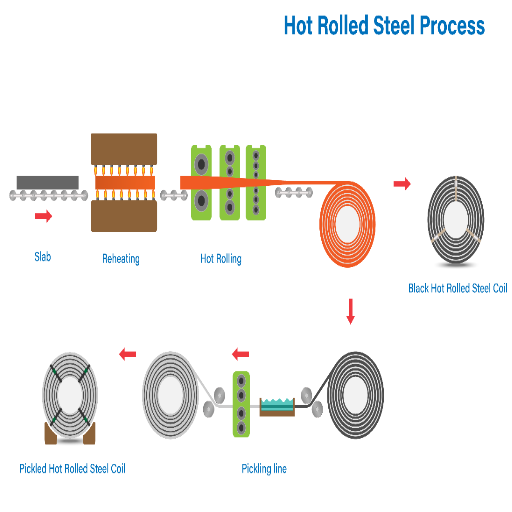
Hot rolled steel is a form of steel that undergoes processing at high temperatures, commonly greater than 1,700°F, above the steel’s recrystallization point. This process begins with large slabs of steel, which are first heated and then put through several rollers to achieve the desired depth and shape. The high temperature enables easy molding and shaping of the steel without compromising structural integrity. After shaping, the steel can cool naturally at room temperature, leading to a rough surface and imprecise dimensions. Hot-rolled steel is widely utilized in industries where tight tolerances and surface finishing are less critical, such as construction, heavy machinery, and railroad tracks.
Understanding the hot-rolled steel process
My goal here is to help you understand the hot-rolled steel process. It usually begins with heating a steel rectangular slab to around 1,700°F or higher, then passing through rollers to attain a desired shape and thickness. The shaped steel can cool naturally at room temperature, leading to a rough surface and imprecise dimensions. This is perfect for construction beams, railroad tracks, or heavy machinary frames where tolerances are not too strict.
Key temperature factors in the production
It is known that temperature is an essential factor in raw material processing and the mechanical properties, strength, and durability of steel. Typically, rolling the steel is done at temperatures between 1200 °C and 1300°C (or 2192°F and 2372°F), as that is the range where the steel is most pliable.
Controlled cooling is significant in the cooling process, as cooling rates must also be considered. Cooling around 600°C to 700°C (1112°F to 1292°F) guarantees consistent grain structure while preventing cracks or deformation. If not done precisely, temperature control may cause surface issues or unexplainable warping, leading to soft and brittle steel.
Essential factors are the environment and initial reheating temperature, the speed at which the material is moved to shaping equipment, and the cooling rate (air or water quench). For high-strength steels and other specialty steels, processes such as annealing or tempering are performed from 400°C to 700°C (752°F to 1292°F). These parameters must be controlled to find the optimal balance between the steel products’ strength, flexibility, and durability.
The importance of industrial applications
Advanced industrial applications are significant in modern society as they provide the materials and tools that support various industries, from construction to automotive. Because of these industries, specialized steel and advanced processes are expertly designed for extreme strength, flexibility, and durability parameters. In my case, precise control of forging temperature parameters, say 900°C to 1250°C (1652°F to 2282°F) for forming operations and tempering of 400°C to 700°C (752°F to 1292°F) results in the desired mechanical properties. These considerations are the foundation of any improvement made to innovations in industrial applications, whose hallmark is unmatched efficiency and reliability in every crafted product.
How does mild steel differ from other steel products?

Mild steel, also known as low-carbon steel, differs from other steel products because of its carbon content, which ranges from 0.05% to 0.25%. Its carbon content makes it more malleable, ductile, and easier to weld than other high-carbon or alloy steels. Even though it requires further treatment to increase hardness and wear-and-tear resistance, it is always less hard and corrosion-resistant. Because of its value and great range of usability, mild steel is often used in construction, automotive manufacturing, and general engineering.
Characteristics of low-carbon steel
Low-carbon steel, or mild steel, is cheap and easy to find. It is well-known for its high ductility, excellent weldability, and superb ease of machining. Its low carbon percentage guarantees higher ductility and greater malleability, ensuring ease of bending, cutting, and shaping into different forms. However, mild steel has some drawbacks, such as lower tensile strength and significantly reduced resistance against corrosion and abrasion. Still, some surface treatments, like galvanizing or coating, help significantly improve performance, which increases usability across the construction and automotive industries.
Mechanical properties and strength of mild steel
Mild Steel is popular for its blend of distinctive properties, making it vital for different sectors. Its mechanical properties include tensile strength between 400 and 550 MPa, giving it sufficient endurance for most purposes without excessive reinforcement. Yield strength is usually 250 to 350 MPa, depending on the grade, which allows the steel to endure operational forces before undergoing permanent stress. Its distinct properties include moderate elongation at break (typically 20-25%), showcasing mild steel’s ductility during fabrication.
As for the material’s indentation or wear resistance, the Brinell hardness number (BHN) for mild steel is estimated to be between 120 and 160. Moreover, mild steel has a density of approximately 7.85 g/cm³, which is essential for design calculation in structural and weight-sensitive designs. Moreover, lower limit of its melting point is roughly1450°C which makes mild steel applicable in many environments but without additional processing, makes the material useless in extreme heat applications.
These distinct properties make the material highly suitable for a considerable range of valuable functions requiring easy machining and affordability without compromising efficiency. However, some surface protection is mandatory due to its corrosive characteristics, making galvanizing or painting essential.
Applications include construction and beyond.
Because of its remarkable ductility, weldability, and tensile strength—typically sitting between 400 and 550 MPa—mild steel is quite popular within the construction industry, particularly in creating structural elements such as beams, columns, and reinforcements. Apart from construction, it is also used in the automobile industry for body panels, chassis, pipes, machinery, and other appliances. Its machinability, cost-effectiveness, and versatility allow it to be used in various projects. For these applications, mild steel requires protective measures against corrosion, such as galvanizing or other coatings.
What are the differences between hot rolled and mild steel?

The main difference between hot rolled and mild steel is in the manufacturing processes and the properties. Hot rolled steel is produced at high temperatures, making it easier to shape and form, but it has rougher surface finishes and is not as dimensionally precise. Alternatively, mild steel is a low-carbon steel best known for its ductility, machinability, and weldability. While hot rolled steel refers to the processing method, and mild steel refers to the composition of the steel. Structural applications prefer hot rolled steel, while general fabrication and day-to-day products utilize mild steel more often.
Comparing finish and surface quality
While comparing the hot-rolled steel and mild steel, I noticed that hot-rolled steel has a finish that is not smooth, and it looks rough and scaly. This is due to cooling after heating it to very high temperatures. Offering applications or components that are more form-sensitive might require processing, such as grinding or sanding. On the other hand, mild steel has a cold rolling process, which gives it a much smoother finish. Mild steel is the better option when the application requires better aesthetics. Hot-rolled steel is better when the structure is the main element, as the finish is unimportant.
Understanding cost implications
Many factors must be considered when evaluating the cost of hot-rolled steel and mild steel. Generally, slipper manufacturing processes, such as moving the metal under high temperatures, make hot-rolled steel more affordable. It is also less precise and less complicated when used in bulk structural applications. While this makes hot-rolled steel cheaper, cold-rolled mild steel has extra expenses. Extra steps such as precise machining, additional finishing to achieve smoother surfaces, and tighter tolerances increase the price of mild steel.
Key aspects affecting cost:
- Manufacturing Process:
-
-
- Hot-rolled steel production is a fast, high-temperature process that cuts production costs.
- Mild steel, especially mill-finished cold-rolled steel, undergoes further processing steps like annealing and polishing, which increases its cost.
-
- Tolerances:
-
-
- Looser tolerances mean hot-rolled steel is less expensive but may not suit applications requiring reasonably tight tolerances.
- Mild steel allows tighter tolerances, which increases the cost of fabrication.
-
- Surface Finish:
-
-
- Hot-rolled steel requires additional refinement for aesthetic and precise applications due to its rough, scaly finish after hot rolling.
- Cold-rolled mild steel is smoother than its counterpart, making it suitable for applications with strict surface requirements.
-
- Material Grades:
-
-
- Both materials may vary in grade and composition, impacting price depending on specific alloying elements and their properties.
-
Both materials may vary in grade and composition, impacting price depending on specific alloying elements and their properties.
Which form is best for your project?
The best form for your project is determined through its requirements. After my research, I found that hot-rolled steel works best when cost-effectiveness and structural integrity are needed, such as in construction beams or welded frames. It is used when higher tolerances or smoother finishes are unnecessary, as it may have rougher surfaces with more lossy dimensions. In contrast, mild steel, especially the cold-rolled variety, is preferable when higher standards of smoother surfaces, pleasing aesthetics, or tight tolerances are required, such as in automotive parts or furniture fabrication. Important factors include:
- Tolerance:
-
-
- Hot-rolled steel usually has a broader tolerance.
- Cold-rolled mild steel provides tighter and more accurate relative dimensions with greater precision.
-
- Surface Finish:
-
-
- Post-processing for hot rolled steel involves additional steps to improve surface finishes.
- Mild steel has a smoother surface and is ready to use.
-
- Strength and Ductility:
-
-
- Mild steel has a smoother surface and is ready to use.
- Mild steel is expected to have more yield strength due to cold working alongside higher initial yield strength.
-
- Cost:
-
-
- Cold-rolled mild steel is pricier than hot-rolled steel.
-
Evaluate your project’s specifications, such as budget, desired finish, and structural requirements, to determine the most effective choice that produces the most optimal outcomes.
How do you choose the right steel products for your project?

Project Budget:
-
-
- Hot rolled steel might be the best option if cost is a factor since it is cheaper.
-
Surface Finish Needs:
-
-
- Mild steel is perfect for applications that need a smooth and polished surface finish because it is available as a standard.
-
Strength and Structural Requirements:
-
-
- Determine if your project suffers more from hot rolled steel’s ductility or mild steel’s yield strength.
-
Tolerance and Precision:
-
-
- Use cold-rolled mild steel for tighter tolerances, especially for projects that require exact measurements and shapes.
-
Identifying project priorities allows the selection of the steel product that best balances performance, appearance, and cost.
Evaluating specific applications and needs
When choosing between the types of steel for a project, the following factors, along with their considerations, should be kept in mind:
- Cost Efficiency:
-
-
- If the project is cost-driven, hot-rolled steel is the most economical option. Its price is lower because it undergoes fewer steps in the manufacturing process.
- Approximate Price Range (as of 2023):
- Hot Rolled Steel – $600 to $800 per ton
- Cold Rolled Mild Steel – $800 to $1200 per ton.
-
- Surface Finish Requirements:
-
-
- Polished finishes suit surfaces such as furniture, appliances, and precision instruments. Cold-rolled mild steel is preferred for such applications.
- Typical Surface Roughness:
- Hot Rolled Steel – Approximately 12-30 acrylic roughness average (μm Ra).
- Cold Rolled Steel – Less than 10 μm Ra
-
- Strength and Mechanical Properties:
-
-
- Cold-rolled steel is more suitable for applications requiring higher structural strength or more complex surfaces because it has a higher yield strength. On the other hand, hot-rolled steel is better for projects like welding or forming large structures due to its superior ductility.
- Mechanical Properties (varies based on grade):
- Hot Rolled Steel – Yield Strength ~ 210-250 MPa.
- Cold Rolled Mild Steel – Yield Strength ~ 300-400 MPa.
-
- Dimensional Tolerance:
-
-
- Cold-rolled steel is used where accurate numbers, uniform thickness, or more stringent limits are required (e.g., in the automotive industry or other manufacturing parts).
- Dimensional Tolerance:
- Hot Rolled Steel – +/- 2-5% on thickness.
- Cold Rolled Steel – +/- 0.2-0.5% on thickness.
-
- Environmental Factors:
-
-
- Other surface treatments or material grades, such as galvanized steel, may be necessary depending on the working environment, exposure to very high or low temperatures, or corrosion.
-
Analyzing the technical aspects provided can help you reach a conclusion based on your project’s requirements. However, you should always check the manufacturer’s specs for specialized or high-performance applications to determine their actual capability claims.
Considering supplier options and offerings
To begin with, I check the supplier’s material credentials, such as their ISO 9001 certification, to ensure they follow the required manufacturing processes. Next, I consider pricing and lead times to determine whether these factors meet my project’s budget and schedule. Lastly, I investigate other offered services, such as custom-cut lengths, surface treatment, or technical assistance. Corrosion resistance, yield strength, tensile strength, and tolerance must be measured, as they influence the material’s performance.
Why is hot-rolled steel commonly chosen for industrial projects?

The versatility and affordability of hot-rolled steel make it a favorable selection for industrial projects. Many industries reap the economic benefits associated with the hot-rolling manufacturing process, which permits the mass production of steel at a reduced cost. Its excellent workability further enables easy fabrication and welding. Its available shapes and sizes make hot-rolled steel even more desirable, as it withstands demanding environments and offers strength and durability.
The benefits of durability and cost-effectiveness
Since hot-rolled steel is employed in many industrial projects, it is readily available and ranks high due to its fantastic affordability and unmatched durability. It possesses the strength required to endure immense impacts, heavy loads, extreme climatic temperatures, and even harsh corrosive conditions. This enables the steel to withstand everything needed to construct infrastructure, along with heavy machinery and a robust framework.
Meanwhile, hot-rolled steel’s price efficiency comes from its manufacturing method. Steel is worked on at high temperatures during the hot rolling process, making it easier to produce and reducing costs. Additionally, hot-rolled steel often requires little processing afterward, decreasing expenses. Its standard shapes and sizes also mean that material wastage is lower, and customization costs less.
- Tensile Strength: Depending on the grade, it ranges from 45,000 to 80,000 psi (310-550 MPa).
- Yield Strength: Ranges from 33,000 to 70,000 psi (230-480 MPa), ideal for dependable structural support.
- Corrosion Resistance: Provides more excellent protection when used with appropriate surface treatments like galvanizing or coating.
- Dimensional Tolerances: Hot-rolled steel has wider tolerances than cold-rolled steel, making it appropriate for less exact applications.
Hot-rolled steel is ideal for various industries, including construction and manufacturing. Its strength and durability are crucial while remaining affordable.
Examples of applications in industrial settings
The usefulness of hot-rolled steel in various industries is due to its hoisted strength, versatility, and affordability. Moreover, it is commonly used in producing heavy machinery parts such as frames and supports, taking advantage of its yield strength (about 70,000 psi) for dependable performance under strain. Additionally, hot-rolled steel is widely used in constructing I-beams and Structural components and possesses a high tensile strength of almost 80,000 psi. Moreover, it is used in manufacturing pipelines and storage tanks where surface treatments enhance corrosion resistance. These features showcase its properties and effectiveness in extreme circumstances such as harsh industrial environments.
References
Frequently Asked Questions (FAQ)
Q: What is hot rolled steel?
A: Hot-rolled steel is processed at high temperatures, typically above the material’s recrystallization temperature. This technique allows the steel sheet to be shaped and formed easily, making it best suited for large-scale manufacturing and construction applications.
Q: How does hot-rolled steel differ from cold-rolled steel?
A: The primary difference between hot-rolled and cold-rolled steel is the temperature at which they are processed. Hot-rolled steel is processed at high temperatures, allowing for easier shaping, while cold-rolled steel is processed at room temperature, resulting in a more precise and attractive finish. Cold-rolled steel is typically used for applications requiring tight tolerances and a smoother surface.
Q: What is mild steel, and how is it related to hot-rolled steel?
A: Mild steel, often referred to as low-carbon steel, is a type of steel that contains a small amount of carbon. It is commonly produced as hot-rolled steel because it offers a cost-effective way to create steel sheets and plates suitable for various applications due to their malleability and ductility.
Q: What are the specifications of A36 steel?
A: A36 is a standard specification for hot rolled steel defined by its chemical composition and mechanical properties. It is a type of low-carbon steel under the ASTM standard known for its strength and versatility in the construction and manufacturing industries. A36 steel is best suited for structural applications such as building frames and bridges.
Q: Why is hot-rolled steel typically used in construction?
A: Hot-rolled steel is typically used in construction due to its strength, durability, and ability to be easily shaped into larger sections. These properties make it ideal for structural applications, where the steel sheet or plate can be used to form beams, columns, and other components needed for building and infrastructure projects.
Q: Are there any limitations to using hot-rolled steel?
A: One limitation of hot-rolled steel is that it has a rougher surface finish than cold-rolled steel, making it less attractive for applications where appearance is essential. Additionally, the dimensional tolerances of hot-rolled steel are not as precise as those of cold-rolled steel, making it less suitable for parts that require tight specifications.
Q: How can I find more detailed information about hot rolled and mild steel?
A: For more detailed information about hot-rolled steel and mild steel, including their specifications, applications, and availability, contact local steel suppliers or manufacturers. They can provide comprehensive data sheets and technical support tailored to your needs and location.
Q: What are the advantages of using hot-rolled steel sheets?
A: Hot-rolled steel sheets offer several advantages, including lower costs, flexibility in shaping, and the ability to create a wide range of sizes. These benefits make them an attractive option for industries that require large quantities of material with less stringent aesthetic requirements.
Q: How does the manufacturing process of hot-rolled steel affect its properties?
A: The manufacturing process of hot rolled steel, which involves heating and pressing the material at high temperatures, affects its properties by allowing for easier shaping and forming. This results in a product with a more uniform grain structure, more excellent ductility, and better weldability than cold-rolled steel.


