
Steel is one of the most valuable materials to industries and businesses, from construction to automotive endeavors. However, every kind of steel has its purpose and application. This article explains the differences between hot-rolled steel and cold-rolled steel. We’ll break down their in-depth production processes alongside their industries and key properties. This also includes their advantages and how they help other industries. Lastly, we will tailor our focus on cold-finished steel, its best-suited attributes, unique characteristics, scope of application, and rationale behind its use for your project. After reading this post, you will have an insightful understanding of the different types of steel, which will aid you in making decisions based on your design requirements.
What is the fundamental difference between hot-rolled and cold-rolled steel?

Hot-rolled and cold-rolled steel’s initial and final processes differ in their processing and characteristics. Hot-rolled steel is shaped and formed at very high temperatures, making it easier to process. This method, however, results in less accuracy with surface finish and dimensions, which are usually rougher and broader. Cold-rolled steel, in contrast, is processed further at room temperature. As a result, surface finishing borders on exceptional while strength, accuracy, and precision improve radically. This outstanding quality is highly sought in industries where rough tolerances are banned.
How temperature affects the steel manufacturing process
Steel’s temperature and the methods used to manufacture it are directly related to the material’s properties and how malleable it is. Processes that use very high temperatures, like hot rolling, make it easy to shape steel, which comes with the downside of having fierce precision and accuracy issues alongside a rougher surface. With cold rolling, the compliments associated with low temperatures become available. The stronger the steel, the higher the accuracy of the dimensions, and the better the surface finish, all while increasing the temperature to room temperature. These processes highlight the specific steel strength, finish, and tolerances requirements.
Key differences in surface finish between hot-rolled steel and cold-rolled steel
Due to the processes of hot-rolled steel, it has a rough and scaled surface finish. This scaling occurs as a result of oxidation on the steel’s rolling surface. Because the surface is not smooth, hot-rolled steel is best used where precise dimensions and aesthetics do not matter. It is generally used to construct structures, railways, heavy machinery, etc. These structures focus more on strength, durability, and cost-efficiency than looks.
Unlike hot-rolled steel, cold-rolled steel undergoes cleaning, annealing, and further rolling at room temperature. This results in a smoother surface and helps achieve tighter dimensional tolerances. The cold-rolling operation improves the surface to an acceptable level. It enhances other mechanical properties such as tensile strength and hardness, making it ideal for precision manufacturing of automotive parts, furniture, and even home appliances where looks and accuracy are key.
- Surface Roughness:
- Hot-Rolled Steel: ~100–500 µin (microinches) RA.
- Cold-Rolled Steel: ~10–100 µin RA.
- Dimensional Tolerance:
- Hot-rolled steel: ±0.01–0.05 inches.
- Cold-rolled steel: ±0.005–0.01 inches.
- Scale Formation:
- Hot-Rolled Steel: Abundant because of oxidation during reheating processes.
- Cold-Rolled Steel: Non or very minimal, as post-processing removes scaling.
Understanding how cold rolling changes the properties of hot-rolled steel
The properties of hot-rolled steel are significantly improved by cold rolling through surface finishing, increasing strength, and enhancing the accuracy of dimensions. Steel is deformed at room temperature during cold rolling, which scrunches up the structure and removes hot rolling-related defects. Precision tighter tolerances of ±0.005–0.01 inches are achievable, smooth surface finish of ~10–100 µin RA, and narrower dimensional tolerances. Moreover, cold rolling increases yield and tensile strength from work hardening while decreasing ductility. These enhanced features make cold-rolled steel preferable for use in tools that need high-grade finishing and precision.
What exactly is cold-finished steel, and how is it produced?
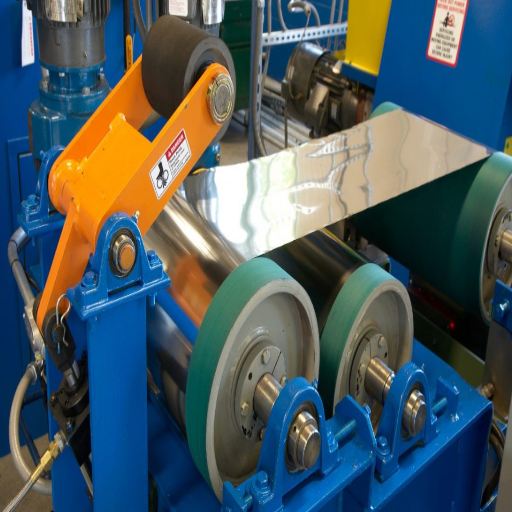
After the hot rolling phase, further steel processing is called ‘cold finished steel.’ Cold drawing, turning, grinding, or polishing is usually done to obtain a smooth surface finish and specific dimensions. Processes usually start from hot rolled steel, after which the steel is processed at room temperature. The material is either pulled through dies or sent through rollers to improve the shape, dimensional accuracy, and mechanical properties like strength and hardness. Because of its varied advantages, cold-finished steel is frequently used in situations requiring complex surface finishes and stringent tolerances, such as steel for shafts.
The cold drawing process is explained.
The drawing process is completed by pulling out or drawing the desired metal rod through a die onto a spool to achieve a smoother surface finish, enhanced mechanical parameters, and adjusted dimensions. Material preparation requires removing surface contaminants by pickling and lubricating to minimize friction during the drawing. The prepared barrel is pulled through the die, narrowing its diameter and reshaping it per requirements. The abovementioned processes yield materials with higher tensile strength and hardness and enhanced overall quality, which are essential in high-performance applications with stringent tolerance requirements.
How cold-finished steel bars are manufactured at room temperature
Creating ccf bars, called ‘cold finished steel bars,’ requires room temperature processes. Primarily, cold-finished steel bars require the material’s surface, physical properties, and shape to be changed for the better during the entire procedure. The procedure starts with hot rolled steel, where the surface and scale imperfections are removed through pickling or shot blasting. Then, further shaping is accomplished by pulling the steel through a die at room temperature. This increases the tensile strength of the material and makes it more challenging.
Key aspects involved include:
- Reduction Ratio: Size reduction often ranges between 10% and 40%, and changes in mechanical properties drive this variable.
- Tensile Strength: Drawing increases tensile strength by 10-40%. The extent of this change depends on the alloy used and the reduction ratio.
- Dimensional Tolerance: Achievable tolerances reach up to ±0.001 inches, which is remarkably precise.
- Surface Finish: The surface is polished further, so surface roughness reaches 16-63 micro-inches (Ra), the standard for cold-finished bars.
- Yield Strength: Strain hardening increases yield strength, positively affecting load-bearing performance.
Correcting any drawing-induced distortions may require straightening as a final step in production. The finished bars are then trimmed to length and subjected to quality control inspections to confirm that they comply with rigorous industry standards for high-performance applications.
Differences between cold rolling and cold drawing techniques
There is a distinction between cold rolling and cold drawing in metalworking processes. Cold rolling involves passing the metal through rollers, which reduces the thickness of the metal sheet while enhancing its surface finish. This technique is ideal for fabricating uniform strip and sheet products. In contrast, cold drawing involves pulling metal through a die to obtain a specific shape and precise dimensions. It is commonly applied to bars and tubes where higher accuracy in dimensions is required, along with better mechanical properties.
Key aspects include:
- Cold Rolling:
- Reduction Ratio: Generally 10–50%.
- Surface Finish: Smother, with a range of 16 to 63 micro inches (Ra) standard for rolled material.
- Strength Improvement: Moderate because of strain induced by rolling.
- Cold Drawing:
- Reduction Ratio per Pass: Approximately 20–45%.
- Surface Finish: Fine and often exceeding that of cold rolling at similar Ra values.
- Yield Strength Improvement: Significant due to the strain hardening from drawing.
Choosing between two methods depends on product specifications and application needs, which illustrates the versatility within metallurgical engineering.
What are the advantages and disadvantages of hot-rolled steel?
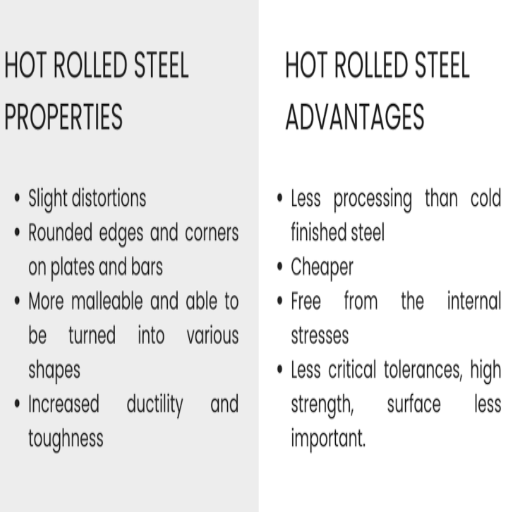
Advantages of Hot Rolled Steel:
- Cost-Effective: The process is less expensive because of low energy usage and minimal machining steps.
- More straightforward to Work With: Increased temperatures within the processing stage make the steel more pliable and easier to shape.
- Versatile Applications: Appropriate for large structural parts as well as general-purpose applications.
- Reduced Residual Stress: The rate of internal tension build-up is significantly lowered during the cooling stage.
Disadvantages of Hot Rolled Steel:
- Surface Finish: Hot-rolled steel has a rough, scaled surface that does not provide the desired aesthetic and may require further treatment for precision.
- Dimensional Accuracy: The dimensions of hot-rolled steel are less precise due to shrinkage during the cooling process.
- Susceptibility to Rust: Hot rolled steel requires a protective coating because the scaled surface is not corrosion-resistant.
When to use hot rolled steel in applications
I would employ hot-rolled steel in areas where accuracy and surface finish precision are not mandatory. In construction beams, rail tracks, and other significant structural components, the material has less cost and can withstand considerable stresses, which makes it ideal for massive machinery projects. Furthermore, it is useful when transforming its dimensions or surface, such as by machining or surface treatment, which will significantly improve its appearance. When precision wrought elements are not feasible, and strength and cost-effectiveness are of primary importance, hot rolled steel is the best option, wherein precision is sacrificed.
Why hot rolled steel tends to be more economical
Hot-rolled steel is more economically favorable mainly due to the intricacy-less design-steered manufacturing process. While producing the steel, the material is rolled at temperatures higher than 1700°F (926°C), and its recrystallization range is usually above. This prevents any steel reheating, saving energy and labor, ultimately leading to lowered production costs. Furthermore, with the increased temperature comes an increased processing speed. This, paired with the ability to create an ‘x’ amount of materials in ‘y’ time, results in sufficient cost efficiency.
From a technical standpoint, the economical nature of hot-rolled steel can also be due to:
- Manufacturing Costs: Submitting post-process treatments, including powerful annealing or excessive finishing, directly reduces costs.
- Material Dimensions: Regarding Hot Rolling, larger cross sections and longer lengths can be produced with little wastage, which works well for bulk applications.
- Tolerance Levels: Hot-rolled steel has looser dimensional tolerances than cold-rolled steel. However, this is defendable in cases where precision is inconsequential due to significant secondary savings in other processes.
These cumulatively make hot-rolled steel optimal for cost-sensitive construction, transportation, and industrial manufacturing projects.
Surface characteristics and dimensional tolerance limitations
Typically, hot-rolled steel possesses a rough surface texture due to high-temperature processing and scale from air exposure. This surface finish grade is acceptable in cases where visual appeal is not required; however, treatments like pickling or grinding may be needed for beauty or accurate measurement. In addition to these processes, further refining or polishing can be employed to achieve the desired outcome. The dimensional tolerances of hot rolled strip steel are also not as tight as cold rolled strip steel. These are usually looser, with most variations around the order of ±2-5% based on the material’s thickness and width. For structural purposes, these are acceptable, but components that require greater precision will often need additional refinement.
What makes cold-rolled steel preferable for specific applications?

The application of cold rolled steel is specific to industries and regions as it is more beneficial because of the superior surface finish, enhanced mechanical properties, and tighter dimension tolerances. The appearance of steel is smoother, which is obtained from the cold rolling process, and because of the increase in the strength of the steel and its hardness. These attributes make steel cold rolling suitable for the automotive industry, appliances, and furniture, requiring precision and tight tolerances.
Precision and improved surface finish of cold-rolled steel
Because of its manufacturing process, cold-rolled steel has a high surface finish and exceptional precision. Compressing steel at room temperature produces polished and smoother surfaces, which results in tighter dimension tolerances. The process improves strength and hardness, making it optimal for aesthetic-sensitive industries like automotive, home appliances, and furniture. Therefore, cold-rolled steel is an outstanding project that is suitable for a refined and durable appearance.
How cold work affects the mechanical properties of steel
Cold working, or work hardening, entails a process that increases the strength and hardness of steel, significantly modifying its mechanical properties through deformation at room temperature. Because of dislocation movement in the steel’s crystalline structure, ductility is reduced while yield and tensile strength improve, enhancing the material’s crystalline structure.
The essential aspects of cold work and how it impacts steel’s properties include the following:
- Yield Strength: It tends to atrophy significantly, increasing anywhere from 50% to 100%, depending on the amount of deformation.
- Tensile Strength: The stretch steel can handle is enhanced, increasing from 10% to 30%.
- Hardness: Enhanced wear resistance contributes to its frequent increase of 20% to 40% of its value.
- Ductility: With further processing, the pliability is reduced by nearly 30% to 50%.
- Grain Structure: Although toughness may be diminished, strength is enhanced due to the improvement in grain size.
Cold working is used in constructing automotive parts, industrial equipment, and even construction supplies because it requires precise measurements and enhances surface quality. However, too much of it can increase brittleness, requiring processes to restore ductility if additional shaping is needed.
Applications where cold-finished steel is essentially required
Cold-finished steel is undoubtedly the way for applications requiring high accuracy, strength, and polished surfaces. For instance, it is commonly used in shafting applications because its smooth surfaces and precise dimensional measurements significantly improve functionality and performance. Also, cold-finished steel is essential when producing gears since being exact plays a vital role in smooth motion transmission. Additional essential applications are found in fasteners such as screws and bolts, which require high strength and polished surfaces, as these components need to endure stress, ensuring long-term resistance against failure, even in harsh environments. Typical technical specifications include, for some of the more demanding uses, surface roughness parameters in the order of micrometers, which translates to 16 to 125 microinches, and dimensional tolerances as precise as ±0.001 inches. These standards ensure reliability and proper performance in highly demanding environments.
How do you choose between hot or cold rolled steel for your project?

The choice between hot-rolled and cold-rolled steel depends on the project’s requirements. Hot-rolled steel is cost-effective and easy to use. It is best for structural applications that do not need individual portions to meet precise specifications since they can be manufactured to rough outlines. Cold-rolled steel is ideal for high precision, strength, or aesthetic components due to its superior finish and tight tolerances. Evaluate your budget, strength, finish, and accuracy before deciding.
Comparing costs between rolled and cold rolled steel
Hot-rolled steel is likely more affordable than cold-rolled steel because of its ease of manufacturing. The expenditure on the heating and shaping processes done on the steel without any finishing touches is considerably lower than the expense of finishing procedures for cold-rolled steel, which include sharpening surfaces, increasing strength, and reducing tolerances. Overall, weigh the specifications and quality needed from the project against budget constraints to determine if hot-rolled steel is the better option.
Evaluating steel type based on your finished product requirements
A project requiring hot-rolled or cold-rolled steel will primarily depend on the end product’s requirements, such as strength, surface finish, tolerance, and cost. These factors must be evaluated before deciding which type of steel to use. Below is a summary for comparison:
- Hot Rolled Steel:
-
-
- Best For: Construction beams, tanks, and railroad tracks where a precise shape and smooth finish are not necessary.
- Advantages:
- Cost is lowered due to less complicated processes.
- It works well for mass production because it can quickly form into other shapes.
- Considerations:
- Hot-rolled steel is weaker regarding surface finish and dimensional accuracy than cold-rolled steel.
-
- Cold Rolled Steel:
-
-
- Best For: Custom furniture, appliances, and automotive panels require high precision, smooth surfaces, or precision performance.
- Advantages:
- Enhanced strength and tighter dimensional tolerances.
- The superior quality of the surface makes it more desirable for post-finishing processes like painting and plating.
- Considerations:
- More expensive than hot-rolled steel.
- Less suitable for heavy-duty structural applications.
-
In summary, the decision will always depend on the project’s requirements. Hot-rolled steel will work just fine for a low-priced, heavy application. Conversely, cold-rolled steel will perform significantly better in precise applications that require high durability.
Industries that typically use hot-rolled steel vs cold-finished steel
According to my research, hot-rolled steel is used in industries where cost is the primary factor and materials are needed for large, heavy-duty applications. These include construction, shipbuilding, and automotive manufacturing. For example, structural beams, railway tracks, and large-scale equipment are frequently manufactured using hot-rolled steel because of their value and durability. Hot-rolled steel is also less costly because it’s more brittle. Usual tolerances for hot rolled steel are less precise, about +/- 0.01 to 0.03 inches, which is suitable for less critical applications.
By contrast, cold-finished steel has a definite spot in industries that value accuracy, surface finish, and tighter tolerances. This includes aerospace and engineering as well as consumer goods manufacturing. Components such as gears, shafts, and machine parts of sophisticated equipment withstand significant stress levels, so cold-finished steel is relied on because of its smooth surface and precise dimensions. The tolerances for these are about +/- 0.005 inches. Moreover, cold-finished steel is known to have relatively higher yield strength, which is approximately 60,000 to 85,000 psi.
What are the common types of cold-finished steel bars that are available?

There are several types of cold-finished steel bars with unique characteristics that serve different purposes:
- Cold-drawn bars are the most commonly used bars. They have better dimensional accuracy and improved mechanical properties than other types. They are primarily used in manufacturing fasteners and shaft precision components.
- Ground and Polished Bars are perfect for automotive parts and machinery due to their high surface finish, tight tolerances, and exceptional aesthetic appeal.
- Turned and Polished Bars—These bars are best suited for structural components and heavy-duty machinery due to their smooth surface and improved strength.
- Cold-finished flats and Squares are versatile and utilitarian. Due to their reliability and uniformity, they are used in construction, tool-making, and various custom fabrications.
Every steel bar type fulfills its purpose, guaranteeing that different industrial and commercial needs are met.
Popular dimensions and specifications for cold-finished steel bar
To satisfy the requirements of various applications, cold-finished steel bars are offered in numerous shapes and sizes. Usually, the diameters start from 1/8 inch to 12 inches, accommodating both significant structural needs and small precision tasks. These precise measurements are essential across numerous industries. Some common shapes include rounds, squares, hexagons, and flats. Furthermore, some standard specifications, such as the ASTM A108 for carbon and alloy steel bars, are usually set for consistent performance and quality. In addition, soot levels and surface finishes differ, from turned and polished to precision ground surfaces, all of which have distinct mechanical and aesthetic features.
Sheet metal options in cold-finished steel
Cold-finished steel sheet metal is particularly popular in numerous industries due to its unparalleled mechanical properties, surface quality, and dimensional precision. These sheets are readily available across suppliers in common grades such as 1018, 1045, and A36. Each comes with its specifications and is best suited for distinct applications. The standard thickness lies between 0.024 and 0.190 inches, making these sheets adaptable for light and heavy-duty tasks. Standard sheet sizes include 120″ x 48″ and 96″ x 48″ but can be customized to preferred dimensions.
Cold-finished steel sheets possess finer tolerances than hot-rolled sheets, enhancing uniformity and diminishing deviations in material properties. Standard surface finishes for these sheets include matte, polished, and brushed, which fulfill aesthetic and functional purposes. Due to the precision needed in device enclosures and assembly, they are used extensively in the aerospace and automotive industries, appliances, and electronics. Moreover, these sheets comply with the ASTM A1008 and ASTM A568 standards, guaranteeing reliability and performance consistency.
Specialty cold-drawn steel varieties and their uses
The different alloys crafted for specific applications across industries make specialty cold-drawn steel grades enjoyable. I find alloys like 1144 (StressProof®) and 12L14 particularly remarkable due to their advantages. As an illustration, the strength and high machinability exhibited by 1144 make it popular for use in shafts and industrial equipment for precision work. It has a tensile strength of 115,000 to 125,000 psi, thus the yield strength of his 100,000 psi is durable. In contrast, the low tensile strength of about 78,000 psi makes 12L14 leaded-free machining steel ideal for the low-cost production of small parts like fittings and fasteners. Brinell hardness of 149 would also aid in withstanding impact. To summarize, these materials effectively fulfill the needs of advanced manufacturing due to superior mechanical properties and exceptional dimensional accuracy for intricate details.
References
Frequently Asked Questions (FAQ)
Q: What are the key differences between hot-rolled and cold-rolled steel?
A: The main differences between hot-rolled and cold-rolled steel lie in their processing and applications. Hot-rolled steel is essentially hot-rolled at high temperatures, making it easier to shape and form. On the other hand, cold-rolled steel undergoes additional processing at room temperature, resulting in a smoother finish and more precise dimensions.
Q: How is cold-finished steel different from hot-rolled steel?
A: Cold-finished steel is produced through cold drawing or cold rolling. It takes hot-rolled steel and further processes it to achieve an improved surface finish and tighter dimensional tolerances. This makes cold-finished steel bars more suitable for applications where precision is critical.
Q: What is cold-drawn steel, and how is it used in applications?
A: Cold-drawn steel is a type of cold-finished steel pulled through a die to reduce its diameter and improve its mechanical properties. It is often used in applications requiring high strength and precision, such as in manufacturing shafts, gears, and fasteners.
Q: Why is a finished steel bar preferred for specific applications?
A: Cold-finished steel bars are preferred in applications that demand tighter tolerances, better surface finish, and enhanced mechanical properties. They are often used in applications like precision machining, where these characteristics are crucial for the end product’s performance.
Q: Can you explain the process of cold rolling?
A: Cold rolling is done at room temperature to reduce steel’s thickness further and improve its surface quality. This process involves passing the steel through rollers to compress and elongate it, enhancing its strength and hardness compared to cold-rolled steel.
Q: What are the advantages of using cold-rolled metal over hot-rolled?
A: Cold-rolled metal offers a smoother finish, greater dimensional accuracy, and improved mechanical properties. These benefits make it more suitable for high-precision applications than hot rolled steel, which is often used in applications where finish and precision are less critical.
Q: How does the production of cold-finished bars differ from hot-rolled bars?
A: Cold-finished bars are produced by further processing hot-rolled bars through cold drawing or cold-rolling techniques. This additional processing enhances their surface finish and dimensional accuracy, unlike hot-rolled bars, which are typically used in applications where such precision is not required.
Q: Are there any limitations to using cold-rolled steel?
A: Cold-rolled steel offers numerous advantages but is generally more costly than hot-rolled steel due to the additional processing involved. Additionally, it may not be suitable for applications requiring large structural shapes, where hot-rolled steel’s properties are more beneficial.
Q: What types of steel are typically involved in cold-finished processes?
A: Cold-finished processes typically involve low-carbon and medium-carbon steels suited for precision applications. These types of steel are often used in applications requiring high strength, ductility, and superior surface finish.


