
Not all grades of stainless steel are the same. 304 and 316 stainless steel are two of the most commonly used types because they have distinct properties and applications. This blog post aims to compare the two alloys in depth so that you know their differences, strengths, and best-suited applications. Understanding the differences between 304 and 316 stainless steel helps make industrial, marine, or consumer product-related projects. We will discuss their chemical compositions, corrosion resistance, cost-effectiveness, and other factors to build a clear understanding of each.
What is the difference between 304 and 316 Stainless Steel?

Both 304 and 316 stainless steel are extensively used forms of stainless steel, though they significantly differ because of their chemical composition. 304 stainless steel has 18% chromium and 8% nickel, which is a good option for general-purpose stainless steel because it is reasonably corrosion-resistant and durable. Meanwhile, 316 stainless steel has 16% chromium, 10% nickel, and molybdenum in composition, which increases its pitting and corrosion resistance. Adding molybdenum makes it susceptible to pitting and corrosion, especially in marine or industrial atmospheres rich in chloride. While 304, the price is economical but does not perform well under harsh situations, 316 is the better option when superior corrosion resistance is required.
Understanding the mechanical properties of 304 and 316
Both 304 and 316 stainless steels are similar because of their austenitic structure, possessing similar mechanical properties, although they differ in performance under certain conditions. 304 stainless steel, for example, has a tensile strength of approximately 515 MPa, with excellent formability and ductility, making it ideal for applications that involve bending or shaping. On the other hand, 316 stainless steel typically has a slightly higher tensile strength, around 520 MPa, due to the added molybdenum, which improves deformational and stress resistance. Both grades have similar hardness, but due to the better composition of 316, it is more suited for extremely high temperatures or corrosive environments. Ultimately, selecting one over the other is determined by the factors to which an application will be subjected.
Exploring the corrosion resistance in 304 vs 316
The corrosion resistance of stainless steel 304 and 316 is different because of the extra molybdenum metal in 316. The 316 is more resistant than 304 because of the extra molybdenum (2-3%), which helps it resist pitting and crevice corrosion. When in contact with chlorides like seawater or de-icing salts, 316 withstands much better. Since 304 has no molybdenum and lower nickel (8-10.5%), it does stand corrosion but does not withstand aggressively challenging conditions.
Key aspects include the following:
- 304 Stainless Steel: Chromium content: 18-20% Nickel content: 8-10.5% Typical tensile strength: ~500 MPa Pitting resistance equivalent number (PREN): ~18-20
- 316 Stainless Steel: Chromium content: 16-18% Nickel content: 10-14% Molybdenum content: 2-3% Typical tensile strength: ~520 MPa Pitting resistance equivalent number (PREN): ~24-26
The 304 on cost is better and becomes best suited for light work in non-extreme environments. However, for salty water, chemicals, or marine exposures, 316 becomes preferred due to better resistance. Withstand environments become the decider for the choice of the grade.
How does molybdenum in 316 affect its properties?
Adding molybdenum in 316 stainless helps improve its resistance to corrosion, especially pitting and crevice corrosion, in the presence of chlorides. Because of that, 316 is very popular in the marine and chemical processing industries. Molybdenum is added between 2 and 3 % to enhance the alloy’s performance under severe conditions. With these amounts of molybdenum, the PREN (Pitting Resistance Equivalent Number) is increased to about 24-26, much better than 304 stainless steel. In addition to that, molybdenum helps retain strength at higher temperatures, which makes the alloy stable under severe conditions.
Why is 304 Stainless Steel vs 316 Important in Manufacturing?
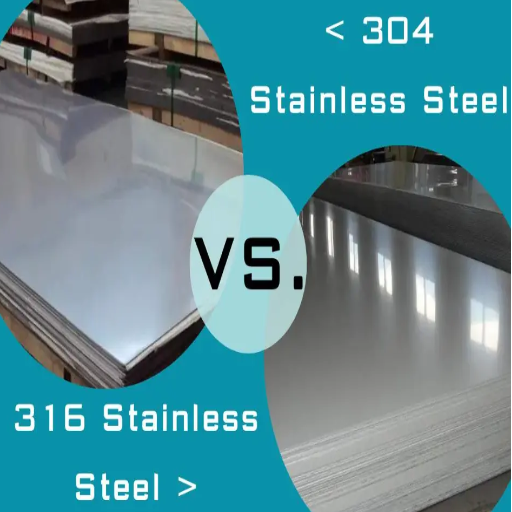
Knowing the differences between 304 and 316 stainless steel is essential in manufacturing because each grade has properties useful for particular applications. While 316 offers added protection against corrosion because of the molybdenum it contains, 304 is more economical and is acceptable for general use. Along with more excellent protection against corrosion, 316 also makes it suitable for chlorides, chemicals, or extreme temperatures. Choosing the correct grade will maximize performance, minimize maintenance, and ensure the most extended service life at the lowest possible cost. This guarantees seamless functioning without undue strain or premature breakdown.
Applications of 304 stainless steel in various industries
Due to its superior strength and resistance to oxidization and corrosion, 304 stainless steel is widely used in various industries. In the food and beverage industry, this material is used for kitchen equipment, food processing machines, and storage tanks because of its cleanliness and ease of maintenance. Due to its strength and appearance, the construction sector uses 304 stainless steel for architectural components, structural supports, railings, and facades. Furthermore, this material is used in the medical and pharmaceutical fields to fabricate surgical instruments, medical devices, and sterilization trays because they can be subjected to thorough cleansing and sterilization.
Why choose 316 stainless steel for superior environments?
316 stainless steel is well known for its advanced performance and enhanced chemical composition. It is corrosive resistant and capable of holding up in highly corrosive environments. The addition of molybdenum (2-3%), chromium (16-18%), and nickel (10-14%) increases its ability to withstand corrosion while further improving pitting resistance in high-salt environments, such as marine applications or chemical processing setups.
Some key Advantages of 316 stainless steel:
- Corrosion Resistance: Provides exceptional resistance to corrosion from chlorides, acids, and alkalis, making it suitable for saline environments and industrial chemical exposure.
- Temperature Tolerance: It serves well in excrete temperatures, high and low, and ensures structural integrity is retained in extreme environments.
- Durability and Strength: Demonstrates more significant ultimate tensile strain.
- Yield Strength: ~290 MPa (42 ksi)
- Tensile Strength: ~580 MPa (84 ksi)
- Melting Point: 2,500°F (1,370°C)
- Density: 8.0 g/cm³
- Maximum Operating Temperature (in oxidative environments): um ~870°C (1,600°F)
316 stainless steel is commonly used in marine, pharmaceutical, and food processing equipment. Steel is also high in stress industries due to their need for stronger corrosion resistance.
The role of austenitic stainless steel in industrial use
Austenitic stainless steel is essential in various industries because it is powerful, versatile, and can resist corrosion. Its non-magnetic nature and excellent weldability make it crucial for the food processing, petrochemical, and marine industries. The stainless steel’s high nickel and chromium content and increased temperature increase durability under extreme conditions. Certain types, such as 316 grade, excel in pitting and crevice corrosion resistance caused by chlorides.
Key Aspects of Austenitic Stainless Steel (General):
- Corrosion Resistance: Best among oxidizing and chloride surroundings.
- Tensile Strength (Typical, 316): ~515 MPa (75 ksi).
- Yield Strength (Typical, 316): ~205 MPa (30 ksi).
- Temperature Range: Functionality maintained up to
870°C (1,600°F) during oxidative activities. - Density: ~8.0 g/cm³.
Meeting the high industrial standards, these properties ensure reliability and efficiency and provide savings in high-stake operations.
How Does Corrosion Resistance Differ in 304 and 316?
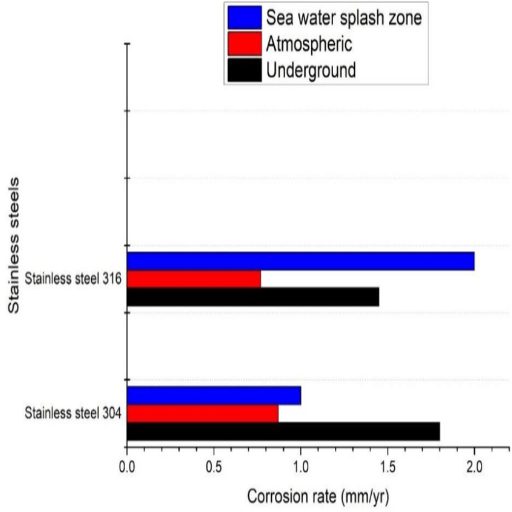
The difference in corrosion resistance distinguishes 304 and 316 stainless steels. Both types maintain a remarkable level of corrosion resistance in relatively benign environments; however, due to the amount of molybdenum present, 316 performs better in harsher conditions. 316 exhibits greater susceptibility to pitting and crevice corrosion in chloride-rich waters like coastal regions or chemical processing industries. 304, on the other hand, is better suited for less harsh environments as it is less resistant to localized corrosion. This discrepancy is significant when choosing a material for a particular industry.
Explaining rust resistance in 304 and 316
I believe 316 stainless steel is the winner compared to 304 in terms of rust resistance because it contains more nickel and molybdenum. They improve their performance in areas with high moisture, salt, or chemicals typical of marine and industrial environments. While 304 offers excellent rust resistance, it is best suited for places that do not have considerable amounts of chlorides and other highly corrosive materials. Consider environmental factors and try to balance which can offer the most corrosion resistance needed for an application to select between the two.
The impact of chloride exposure on both grades
The impact of Chloride exposure is severe on both grades 304 and 316 of stainless steel due to their differing compositions. Chlorides from seawater or deicing salts can cause localized pits called pitting corrosion, which is very dangerous to the structure of stainless steel. Grade 304, which contains lower amounts of chromium and nickel and does not have molybdenum, is much more prone to pitting at chloride concentration levels greater than 200 parts per million. In contrast, 316 stainless steel, which has been improved with 2-3% molybdenum, has much more excellent resistance to pitting induced by chlorides and can withstand approximately 1,000 parts per million in chlorides under the same conditions.
Because of its resistance and performance, coastal regions and chemical processing areas with high chloride exposure use 316 stainless steel. However, 304 stainless steel provides a good alternate solution under less severe conditions with low Chloride exposure due to its cost-effectiveness and durability. No matter what grade of stainless steel is chosen, it should be cleaned and maintained regularly.
Comparing the excellent corrosion resistance of 316
Due to its higher molybdenum content (2-3%), 316 stainless steel has superior corrosion resistance, which significantly withstands chloride-pitting and crevice corrosion, making it better than 304 stainless steel. These qualities make 316 suitable for marine settings, chemical processing, and harsh chemical environments. In addition, 316 contains chromium 16-18% and nickel 10-14%, with incredible resistance to 870°C (1598°F) in thermal instances. 316 stainless steel is more reliable for long-term projects in high-risk environments due to its better performance.
What Are the Properties of 304 Stainless Steel?
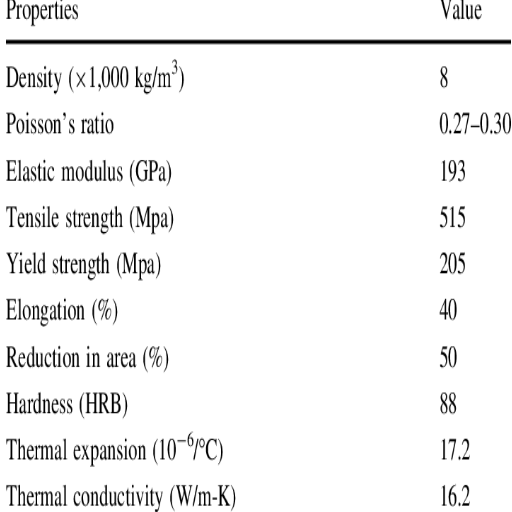
304 stainless steel is one of the most popular types of stainless steel because it is very resistant to corrosion and is versatile. 304 stainless steel contains about 18-20% chromium and 8-10.5% nickel, which make it strong and resist oxidizing. This grade has incessantly wide applications in food processing, kitchen equipment, and even architecture, as it performs well in mildly corrosive conditions, which is a common occurrence. Even though 304 stainless steel is not as corrosion resistant as 316 stainless steel, it is generally corrosion resistant, which makes it cost-effective. It is advantageous for many industries due to its strength, ease of fabrication, and retention of properties at high temperatures.
Analyzing the tensile strength of 304
Based on my research, 304 stainless steel can withstand about 73,200 psi (505 MPa) in the annealed condition, showcasing its tensile strength. Its ability to sustain stress without permanently deforming makes it a good candidate for structural and manufacturing work. Its strength, combined with ductility, protects it from failing due to bending and breaking, making it even more appealing in the food processing and construction industry.
Understanding stainless steel is also about adaptability.
Stainless steel’s vast array of uses in multiple industries stems from its resistance to corrosion, remarkable tensile strength, and adaptability. Different types of stainless-steel alloys provide varying properties to accomplish specific requirements. Depending on their properties, other alloys undergo various processes. For instance, austenitic grades (like 304 and 316) are widely used in food processing and marine environments due to their ease of corrosion introspection. In contrast, ferritic 430 grades are used decoratively since they are less expensive.
Common Aspects of Stainless Steel:
- Corrosion Resistance—Stainless steel’s resistance to rust is corrosion satisfaction, or how well the metal can resist being corroded. In stainless steel, it depends on the composition of chromium, which ranges from 16 to 25 percent, nipple, which ranges from 8 to 10 percent in 304 grade, and molybdenum, which is present in 316 grade, also helps resist chloride attacks.
- Tensile Strength:
-
-
- 304 Stainless Steel (Annealed): ~73,200 psi (505 MPa)
- 316 Stainless Steel (Annealed): ~80,000 psi (550 MPa)
-
- Heat Resistance – Up to 1500 degrees Fahrenheit or 815 degrees Celsius
- Ductility – Need for bending, stretching, or welding. For example, 304 and 316 contain around 40-50 percent breaking elongation.
- Specific weight for the most common types: Roughly 7.9 g/cm³
- Magnetism – The type and level of steel, such as ferritic and martensitic, contain magnets; 304 and 316 austenitic are generally non-magnetic.
Stainless steel is adaptable and recyclable, which impacts ecological matters. Its customizable properties make it flexible, which helps stainless steel hold the first important position for industries like architecture, automotive, healthcare, and energy production.
The versatility of grade 304 stainless steel
Grade 304 stainless steel exhibits incredible versatility because of its degree of corrosion resistance, strength, and ease of fabrication. This material is also best for kitchen equipment, food processing, chemical containers, and architectural-grade buildings. Its 18-20% chromium and 8-10.5% nickel compounds help it be superior and durable. Furthermore, it contains a maximum carbon value of 0.08%, making it easily weldable. The material has an average tensile value of 515 MPa and yield strength of 205 MPa, making it suitable for structural or decorative use. It has an oxidation resistance and low maintenance grade, so grade 304 is preferred by plenty of industries.
How to Choose the Right Grade for Your Needs?

When choosing a grade of stainless steel, consider the steel’s environment. Use grade 316 or higher-resistance steels for areas with high moisture, saltwater, or other harsh chemicals. Where the risk for corrosion is lower, steel grade 304 is versatile, cost-effective, and appropriate for many applications. Also, remember other requirements like the strength and an aesthetic finish to ensure the grade fulfills all expectations. Meeting these criteria will ensure you select the correct grade for your requirements.
Factors to consider when selecting stainless steel grades
When choosing a grade of stainless steel, I like to start with the specific environment. For marine applications or chemical processing, I prefer grade 316 because it is easier to procure and more corrosion-resistant than other grades. I often use grade 304 for general-purpose use since it offers excellent value and performs well in standard conditions. In addition, I think about the amount of mechanical strength needed, ease of fabrication, and the material’s color. Meeting these criteria helps me select the grade that will be functional while also maintaining an aesthetic appeal.
Cost comparison: Is 316 more expensive than 304?
A grade 316 stainless steel will be more costly than a grade 304 due to the additional nickel and molybdenum it contains. These elements make 316 more corrosion-resistant, especially when dealing with chlorides or other harsh environmental factors. This makes it perfect for marine or chemical uses. Usually, the price difference between 304 and 316 is 20%–30%, depending on market conditions and regional supply.
- 304 Stainless Steel:
- Chromium Content: 18-20%
- Nickel Content: 8-10.5%
- Corrosion Resistance: Suitable for general-purpose, standard conditions
- Applications: Kitchen equipment, automotive trims, and architectural structures
- Tensile Strength: ~515 MPa
- 316 Stainless Steel:
- Chromium Content: 16-18%
- Nickel Content: 10-14%
- Molybdenum Content: 2-3%
- Corrosion Resistance: Superior, particularly in saltwater and chemical environments
- Applications: Marine equipment, chemical processing, and medical devices
- Tensile Strength: ~485 MPa
Although 316 withstands corrosion better and has improved durability, 304 is more economical for less aggressive environments. Thus, the choice between the two grades is based on the project’s particular demands.
When is 304 stainless steel vs 316 the best option?
My decision-making on 304 and 316 stainless steel is majorly guided by the setting of use and the application itself. If the project is not in harsh indoor corrosive environments, general use or non-specific, 304 is usually available and sufficient. It is affordable while providing excellent strength and resistance to corrosion when exposed to normal conditions. On the other hand, highly corrosive environments like saltwater, coastal areas, or chemical processing plants would be better served with 316 due to the added molybdenum content, which strengthens resistance to corrosion and pitting.
Some key considerations include:
- 304 Stainless Steel:
- Chromium Content: 18-20%
- Nickel Content: 8-10.5%
- Molybdenum Content: 0%
- Tensile Strength: ~515 MPa
- Corrosion Resistance: Suitable for mildly harsh oxidative environments
- 316 Stainless Steel:
- Chromium Content: 16-18%
- Nickel Content: 10-14%
- Molybdenum Content: 2-3%
- Tensile Strength: ~485 MPa
- Corrosion Resistance: Excellent. Does well in harsh Saltwater, acidic and alkaline environments
Final thoughts: always try to balance cost and operational expenses.
References
Frequently Asked Questions (FAQ)
Q: What is the main difference between 304 and 316 stainless steel?
A: The main difference between 304 and 316 stainless steel is their chemical composition. 316 stainless steel contains molybdenum, which enhances corrosion resistance, especially against chlorides and industrial solvents, compared to 304 stainless steel.
Q: Why would someone choose 316 stainless steel over 304 ss?
A: Someone might choose 316 stainless steel over 304 ss when the application involves exposure to harsh environments, such as marine or chemical processing settings, where superior corrosion resistance is crucial.
Q: What are the key differences between 304 ss and 316 ss?
A: The key differences between 304 and 316 ss include their composition, corrosion resistance, and cost. 316 ss contains molybdenum, offers excellent corrosion resistance, and is typically more expensive than 304 ss.
Q: How does the price of 304 stainless steel compare to 316 stainless steel?
A: Generally, the price of 304 stainless steel is lower than that of 316 stainless steel due to the absence of molybdenum and slightly lower overall corrosion resistance.
Q: What are the physical and mechanical properties of 304 and 316 stainless steel?
A: Both 304 and 316 stainless steel have similar physical and mechanical properties, such as strength and hardness. However, due to its composition, 316 stainless steel is more resistant to corrosion and high temperatures.
Q: What types of stainless steel are considered common grades?
A: The most common grades of stainless steel are 304, 316, and 430. Each grade is suited for different applications based on its properties and resistance levels.
Q: Which type of stainless steel is more resistant to corrosion?
A: 316 stainless steel is more corrosion-resistant than 304 stainless steel, especially in environments with chlorides and acids.
Q: In what applications is 304 ss typically used?
A: 304 ss is typically used in various applications, including kitchen appliances, piping, and automotive trim, where standard corrosion resistance and affordability are key factors.
Q: How do the strength and corrosion resistance of 316 compared to standard carbon steel?
A: Compared to standard carbon steel, 316 stainless steel offers superior corrosion resistance and maintains good strength, making it suitable for demanding environments.
Q: Are there any popular types of stainless steel other than 304 and 316?
A: Yes, other popular types of stainless steel include 430, which is often used in appliances, and 410, which is known for its strength and wear resistance in cutlery and tools.


